
When homeowners hear the term “end-to-end interiors”, it often sounds simple.
One team, one contract, one outcome — a finished home.
In reality, end-to-end interior design is a structured, multi-stage process that involves far more planning, coordination, and technical execution than most clients initially expect.
Understanding this difference early helps avoid confusion, delays, and unnecessary costs later.
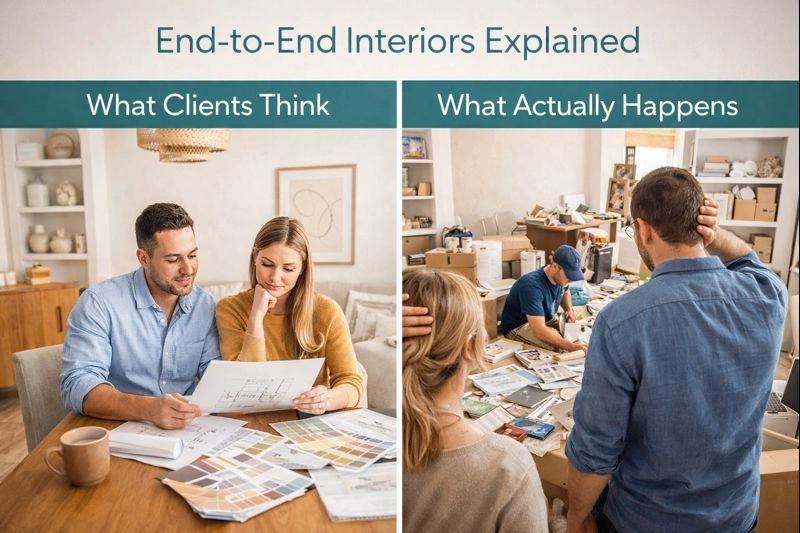
Let’s understand what clients usually think end-to-end interiors include versus what actually happens behind the scenes.
What Clients Usually Think “End-to-End Interiors” Means
From a client’s point of view, end-to-end interiors often means:
- One company handles everything
- Designs are created once and executed exactly
- Work starts quickly after design approval
- Timelines are short and predictable
- Minimal involvement is required from the homeowner
These expectations are understandable — and partially correct.
But they don’t show the full picture.
What End-to-End Interiors Actually Involve
Professional end-to-end interior design is not a single task.
It is a series of coordinated phases, each affecting cost, quality, and timelines.
Let’s break it down clearly.
Phase 1: Understanding the Client & the Space
What clients expect:
“We share our requirements and style preferences.”
What actually happens:
- Lifestyle analysis (how you live, work, store, move)
- Budget alignment
- Site evaluation (structure, services, constraints)
- Practical feasibility checks
Why this matters:
Good interiors are designed around how you live, not just how things look.
Phase 2: Space Planning & Design Development
What clients expect:
“We get a layout and 3D designs.”
What actually happens:
- Detailed space planning
- Furniture layouts based on real dimensions
- Storage planning
- Lighting logic
- Multiple design iterations
3D designs are created to visualize intent, not to replace technical planning.
Phase 3: Technical Drawings & Coordination
This is the most underestimated stage.
What clients expect:
“Execution starts after 3D approval.”
What actually happens:
- Electrical layouts
- Plumbing drawings
- False ceiling plans
- Joinery details
- Coordination with site conditions
These drawings guide contractors and craftsmen during execution.
Without this stage, even good designs fail on site.
Phase 4: Material Selection & Final Specifications
What clients expect:
“We choose finishes.”
What actually happens:
- Budget-based material selection
- Hardware and accessory specifications
- Durability and maintenance evaluation
- Supplier coordination
This phase ensures the design can be built realistically within budget.
Phase 5: Execution & Site Management
What clients expect:
“Work happens smoothly.”
What actually happens:
- Multiple teams working in sequence
- On-site supervision
- Quality checks
- Issue resolution
- Adjustments based on real conditions
Execution is where planning either protects your investment or exposes gaps.
Phase 6: Final Finishing & Handover
What clients expect:
“The home is ready.”
What actually happens:
- Finishing quality checks
- Snag list resolution
- Functional testing (lighting, storage, fittings)
- Final walkthrough
This stage ensures the home is livable, not just visually complete.
Why End-to-End Interiors Cost More — and Save More
End-to-end interiors may seem more expensive upfront.
But they often save money by:
- Reducing rework
- Preventing coordination errors
- Controlling timelines
- Maintaining design intent
The real cost in interiors is doing things twice.
Who Should Choose End-to-End Interiors?
End-to-end interiors are ideal for clients who:
- Want accountability under one team
- Value planning and clarity
- Prefer fewer surprises during execution
- Want a long-term, well-functioning home
It’s not about convenience alone — it’s about risk management.
Our Approach to End-to-End Interiors
At House of Meda, we approach end-to-end interiors as a process, not a package.
Every decision is made with three questions in mind:
1. Will this work long-term?
2. Is this technically sound?
3. Does this justify the client’s investment?
End-to-end interiors aren’t about convenience.
They’re about clarity, accountability, and control.
They’re about clarity, accountability, and control.
We don’t rush homes.
We build them right.
We build them right.
— House of Meda